
How to Choose the Right Casting Process for Your Metal Parts
20.09.2026
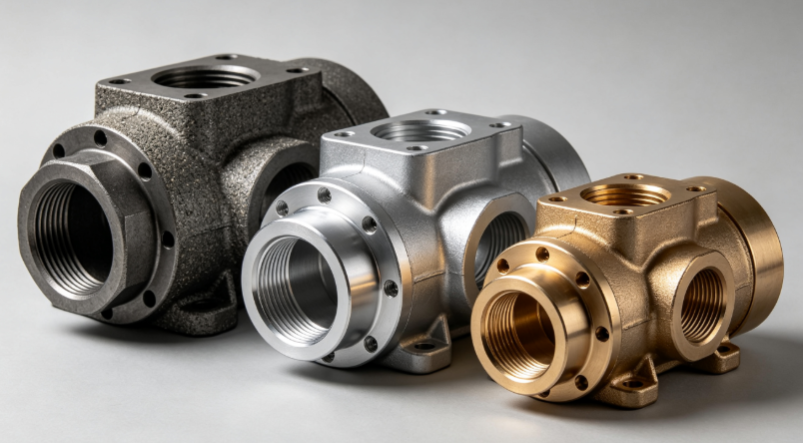
Table of Contents
Introduction
The Three Dominant Casting Processes – An Overview
Sand Casting – The Versatile Workhorse
Investment Casting – Precision for Complex Geometries
Die Casting – High-Volume Consistency
Comparative Performance Data
The Selection Framework – A Practical Decision Guide
Conclusion
Frequently Asked Questions (FAQ)
1. Introduction
The casting process you choose determines more than just how your part is made. It determines cost, lead time, material options, dimensional accuracy, surface finish, and ultimately, whether your product succeeds in the market. Get it wrong, and you're looking at expensive tooling revisions, excessive machining costs, or parts that simply don't meet specification.
The three most common casting processes—sand casting, investment casting, and die casting—each serve different applications. Sand casting offers unmatched material flexibility and low tooling cost. Investment casting delivers precision and complex geometries. Die casting provides high-volume consistency and excellent surface finish. But choosing between them requires understanding the trade-offs. This review examines the key parameters that drive casting process selection and provides a practical framework for making the right decision.
2. The Three Dominant Casting Processes – An Overview
Sand casting is the oldest and most versatile casting method. A sand mold is formed around a pattern, molten metal is poured into the cavity, and the mold is broken to retrieve the part. It works with almost any metal, from steel to aluminum to bronze, and can produce parts from grams to tons.
Investment casting (lost-wax casting) uses a wax pattern coated in ceramic to create a precision mold. The wax is melted out, leaving a cavity that captures fine detail. It delivers excellent surface finish and tight tolerances, particularly for complex geometries and difficult-to-machine alloys.
Die casting forces molten non-ferrous metal—typically aluminum, zinc, or magnesium—into a hardened steel mold under high pressure. The mold can be reused thousands of times, making die casting ideal for high-volume production.
3. Sand Casting – The Versatile Workhorse
3.1 What It Is
Sand casting uses sand mixed with clay or chemical binders to form a mold. The pattern—often made of wood, metal, or plastic—is pressed into the sand to create the cavity. Molten metal is poured in, and once solidified, the mold is broken apart to release the casting.
3.2 Core Advantages
Material flexibility. Sand casting works with virtually any metal: cast iron, steel, aluminum, bronze, brass, and specialty alloys. This is its single greatest advantage over die casting, which is limited to non-ferrous metals.
Low tooling cost. Sand molds are inexpensive compared to permanent metal molds. For low-volume production or prototyping, the tooling investment is minimal. Tooling time is typically 5–7 days.
Large part capability. Sand casting can produce parts weighing from grams to several tons. If your part is too large for die casting, sand casting is often the only option.
Short lead time. Prototypes can be produced quickly—often within days rather than weeks.
3.3 Limitations
Rougher surface finish. Sand grains leave a textured surface. Surface roughness typically ranges from Ra 12.5 to 25 µm.
Lower dimensional accuracy. Tolerances are wider than die or investment casting. Typical dimensional accuracy is ±0.5 mm to ±5 mm. Sand casting generally achieves CT10–CT13 tolerance grades.
Single-use molds. Each sand mold can only be used once, making high-volume production slower and less economical.
3.4 When to Choose Sand Casting
Sand casting is the right choice when:
You need low-cost production for medium or large parts
Your production volume is low to moderate (1–10,000 units)
The part is too large for die casting
You require flexible material choices
The final product can tolerate some machining
You're making a prototype or small batch
4. Investment Casting – Precision for Complex Geometries
4.1 What It Is
Investment casting—also called lost-wax casting—creates a wax pattern of the part, coats it in ceramic slurry, and fires it to create a ceramic shell. The wax is melted out, and molten metal is poured into the cavity. The ceramic shell is then broken away to reveal the finished casting.
4.2 Core Advantages
Excellent dimensional accuracy. Investment casting achieves tolerances of ±0.1 mm to ±0.3 mm, with CT4–CT6 tolerance grades.
Superior surface finish. Surface roughness typically ranges from Ra 1.6 to 6.3 µm. Some sources report as low as 125 Ra microinches.
Complex geometries. Investment casting can produce intricate shapes, thin walls (as low as 2mm), internal channels, and fine details that would be impossible or prohibitively expensive with other methods.
Wide alloy range. It works with stainless steel, carbon steel, alloy steel, nickel-based alloys, tool steel, and many other materials.
Near-net shape. The precision of investment casting often eliminates or significantly reduces post-casting machining.
4.3 Limitations
Higher cost. Investment casting is more expensive than sand casting due to the multi-step process and material costs.
Longer lead time. The wax pattern and ceramic shell production process takes time—typically 4–6 weeks.
Size limitations. Investment casting is generally limited to medium-sized parts, typically 10g to 30kg.
4.4 When to Choose Investment Casting
Investment casting is the right choice when:
The part requires complex geometry, fine detail, or thin walls
You need tight tolerances and excellent surface finish
The alloy is difficult to machine (stainless steel, tool steel, Inconel)
Production volume is low to medium (100–10,000 units)
Post-casting machining costs would be excessive with sand casting
You need near-net shape to minimize secondary operations
5. Die Casting – High-Volume Consistency
5.1 What It Is
Die casting forces molten non-ferrous metal—typically aluminum, zinc, or magnesium—into a hardened steel mold (die) under high pressure. The metal solidifies quickly, the die opens, and the part is ejected. The die can be reused for thousands or even millions of cycles.
5.2 Core Advantages
High production rates. Die casting is fast—production rates can reach up to 200 shots per hour. Once the tooling is set up, the process is highly repeatable.
Excellent dimensional consistency. Die casting achieves the tightest tolerances of the three processes: ±0.02 mm to ±0.1 mm, with CT5–CT7 tolerance grades. Part-to-part consistency is exceptional.
Superior surface finish. Surface roughness typically ranges from Ra 1.6 to 3.2 µm. Parts require minimal post-machining.
Thin walls and complex shapes. Die casting can produce thin-walled, complex parts with excellent detail reproduction.
5.3 Limitations
High tooling cost. Steel dies are expensive—typically $10,000 to $100,000+ depending on size and complexity. This makes die casting uneconomical for low-volume production.
Limited to non-ferrous metals. Die casting works primarily with aluminum, zinc, magnesium, and copper alloys. It cannot cast steel or iron.
Design restrictions. The process requires careful consideration of parting lines, draft angles, ejector pin marks, and slides.
Porosity risk. The high-pressure injection can trap gas, creating porosity that may require secondary processing for pressure-tight applications.
5.4 When to Choose Die Casting
Die casting is the right choice when:
Production volume exceeds 10,000 units per year (and often 20,000+)
Tolerance and consistency are critical
The part is made from aluminum, zinc, or magnesium
You want to minimize post-casting machining
The part is small to medium size with thin wall
You can justify the high tooling investment
6. Comparative Performance Data
The following table provides a side-by-side comparison of the three casting processes across key performance metrics:
Parameter | Sand Casting | Investment Casting | Die Casting |
Dimensional Tolerance | ±0.5 – ±5 mm | ±0.1 – ±0.3 mm | ±0.02 – ±0.1 mm |
Tolerance Grade (CT) | CT10–CT13 | CT4–CT6 | CT5–CT7 |
Surface Roughness (Ra) | 12.5 – 25 µm | 1.6 – 6.3 µm | 1.6 – 3.2 µm |
Tooling Cost | Low ($1K–$10K) | Moderate ($2K–$15K) | High ($10K–$100K+) |
Tooling Lead Time | 5–7 days | 4–6 weeks | 3–4 weeks |
Minimum Wall Thickness | ~4 mm | ~2 mm | ~1 mm |
Material Range | Almost all metals | Most alloys (including steel) | Non-ferrous only (Al, Zn, Mg) |
Typical Part Size | Grams to tons | 10g – 30kg | Small to medium |
Ideal Production Volume | 1 – 10,000 units | 100 – 10,000 units | 10,000+ units |
Typical Lead Time | Short | Medium | Long |
Data compiled from multiple industry sources
7. The Selection Framework – A Practical Decision Guide
7.1 Start with Volume
The single most important criterion is production volume. This determines which processes are economically viable.
1–100 units → Sand casting or CNC machining. Tooling investment is minimal, and the flexibility of sand casting supports design iterations.100–10,000 units → Investment casting offers the best balance of precision, surface finish, and cost. It provides near-net shape without the high die costs.
10,000+ units → Die casting becomes the most economical choice once tooling costs are amortized over high volume.
7.2 Consider Material Compatibility
Steel, iron, or high-temperature alloys → Sand casting or investment casting. Die casting cannot process these materials.
Aluminum, zinc, or magnesium → All three processes are viable. Choose based on volume, tolerance, and cost.
7.3 Evaluate Tolerance and Surface Finish Requirements
Tight tolerances (< ±0.1 mm) and smooth finish → Die casting or investment casting.
Moderate tolerances → Sand casting with secondary machining.
Complex geometries and fine detail → Investment casting is the clear winner.
7.4 Assess Part Size
Large parts (hundreds of kilograms or more) → Sand casting is often the only option.
Small to medium parts → All three processes are possible.
7.5 Consider the Complete Manufacturing Route
The casting process should be evaluated as part of a complete manufacturing route, including模具, casting, machining, finishing, and inspection. A higher-cost casting process that reduces machining and finishing can be more economical overall.
8. Conclusion
The choice between sand casting, investment casting, and die casting comes down to a clear set of trade-offs. Sand casting offers unmatched material flexibility and low tooling cost, making it the right choice for large parts and low volumes. Investment casting delivers precision and complex geometries with a wide range of alloys. Die casting provides high-volume consistency and excellent surface finish at the lowest per-unit cost—but only when the volume justifies the tooling investment.
The data provides clear guidance: sand casting achieves CT10–CT13 tolerances with Ra 12.5–25 µm surface finish. Investment casting achieves CT4–CT6 tolerances with Ra 1.6–6.3 µm finish. Die casting achieves CT5–CT7 tolerances with Ra 1.6–3.2 µm finish. Tooling costs range from low for sand casting to high for die casting.
Start with production volume, then narrow by material, tolerance, and part size. The right casting process delivers the right part at the right cost—not just the cheapest casting, but the most cost-effective complete manufacturing solution.
9. Frequently Asked Questions (FAQ)
Q: What is the cheapest casting process for small batches?
A: Sand casting is generally the cheapest for small batches (1–100 units) because tooling costs are low. For 100–10,000 units, investment casting often provides the best value. For quantities above 10,000 units, die casting typically has the lowest per-unit cost.
Q: Which casting process provides the best surface finish?
A: Die casting provides the best surface finish (Ra 1.6–3.2 µm), followed closely by investment casting (Ra 1.6–6.3 µm). Sand casting has the roughest finish (Ra 12.5–25 µm).
Q: Can die casting be used for steel parts?
A: No. Die casting is limited to non-ferrous metals—primarily aluminum, zinc, and magnesium. Steel and iron parts require sand casting or investment casting.
Q: What is the typical cost of tooling for each process?
A: Sand casting tooling typically costs $1,000–$10,000. Investment casting tooling costs $2,000–$15,000. Die casting tooling costs $10,000–$100,000+ depending on size and complexity.
Q: Which casting process is best for complex geometries?
A: Investment casting is best for complex geometries, fine details, and thin walls. It can produce internal channels and intricate shapes that would be difficult or impossible with other methods.
Q: How does dimensional accuracy compare across casting processes?
A: Die casting achieves the tightest tolerances (±0.02–±0.1 mm), followed by investment casting (±0.1–±0.3 mm). Sand casting has the widest tolerances (±0.5–±5 mm).
Q: Is sand casting suitable for high-volume production?
A: While sand casting can be used for high-volume production, it is generally less economical than die casting for volumes above 10,000 units because each sand mold is single-use.