
Rich Material Grades Optional Precision Forging Components: Carbon Steel, 10.9/12.9 Alloy Steel, 304/316 Stainless Steel, Aluminum Alloy, Titanium Alloy
8/25/2026
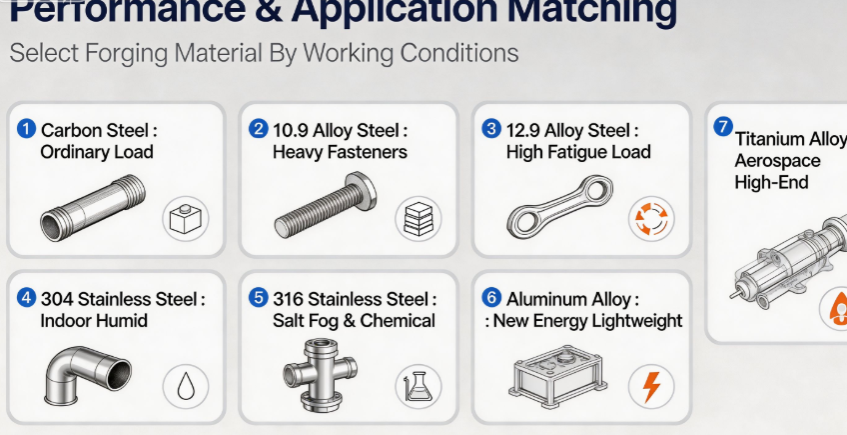
Table of Contents
1. Core Advantages Of Precision Forged Parts & Wide Material Selection Range
2. Performance & Application Matching For Each Optional Forging Material Grade 2.1 General Carbon Steel Precision Forgings For Ordinary Load Structural Parts 2.2 High Tensile 10.9 & 12.9 Grade Alloy Steel For Heavy-Duty Fasteners & Transmission Components 2.3 Corrosion Resistant 304 & 316 Stainless Steel For Humid & Chemical Workshop 2.4 Lightweight High-Strength Aluminum Alloy For New Energy & Auto Lightweight Parts 2.5 Ultra-Light High-Strength Titanium Alloy For Aerospace High-End Equipment
3. Unified Precision Forging Process Applicable To All Material Grades
4. Material Grade Selection Comparison Chart For Different Working Conditions
5. Common Mistakes When Selecting Forging Raw Material Grade
6. Industry FAQ For Auto, New Energy, Marine & Aerospace Equipment Buyers
1. Core Advantages Of Precision Forged Parts & Wide Material Selection Range
Precision forging forms near-net-shape metal components via hot forging, warm forging or cold heading processes, with dense internal metal grain, excellent mechanical strength and less subsequent machining allowance. Unlike simple casting or cutting blank parts, precision forgings have continuous fiber flow along part contour, greatly improving tensile, shear and fatigue resistance under long-term alternating vibration load. Our factory supports rich full-series material grade customization for precision forging production, covering carbon steel, high-strength alloy steel, anti-rust stainless steel, lightweight aluminum alloy and aerospace titanium alloy. Buyers can match exclusive material grade strictly according to equipment load, corrosion environment, lightweight demand and temperature working range, without being limited to single raw material option. These multi-material precision forgings are widely used in auto power systems, new energy battery structural parts, marine anti-corrosion hardware, aerospace connecting components and general mechanical heavy-load brackets.
2. Performance & Application Matching For Each Optional Forging Material Grade
2.1 General Carbon Steel Precision Forgings For Ordinary Load Structural Parts
Conventional carbon steel (Q235, 45#) is the cost-effective basic forging material. After hot precision forging, the internal structure becomes compact, suitable for medium-low load static structural brackets, equipment base connectors and non-critical mechanical fittings without high anti-corrosion requirement. Advantages: Low raw material cost, easy forging forming, stable welding performance, wide supply channels. Limitations: Poor acid and salt fog resistance, low tensile strength, not fit heavy vibration or coastal corrosive workshop.
2.2 High Tensile 10.9 & 12.9 Grade Alloy Steel For Heavy-Duty Fasteners & Transmission Components
40Cr, 42CrMo alloy steel after quenching and tempering reach mechanical standards of grade 10.9 and 12.9 high-strength fastener forgings. Features ultra-high yield strength, strong anti-fatigue performance, excellent resistance to long-time alternating impact and vibration. Core application: Auto engine connecting rod forgings, heavy-load non-standard bolt blanks, gear rough forgings, new energy vehicle suspension structural parts, engineering machinery transmission connectors. Perfect for equipment that bears frequent start-stop impact and continuous dynamic load.
2.3 Corrosion Resistant 304 & 316 Stainless Steel For Humid & Chemical Workshop
304 stainless steel precision forgings resist ordinary atmospheric rust, suitable for indoor humid workshop, food machinery and general water contact equipment parts. 316 stainless steel adds molybdenum element, outstanding resistance to salt fog, weak acid, alkali and marine corrosive medium, standard material for coastal marine equipment and pharmaceutical reaction equipment fittings. Both grades can be precision hot forged into complex irregular blanks, avoid porosity and sand holes common in stainless steel castings, ensure stable sealing and structural strength in corrosive environment.
2.4 Lightweight High-Strength Aluminum Alloy For New Energy & Auto Lightweight Parts
6061, 6063, 7075 series aluminum alloy precision forgings feature low density, light weight, moderate tensile strength and good ductility. 7075 high-strength aluminum alloy forging realizes lightweight while maintaining strong load capacity, widely adopted in new energy battery frame forgings, auto chassis lightweight connecting brackets, electric motor shell rough forgings. Natural anti-oxidation performance, can match anodizing surface treatment to improve wear resistance and decorative effect.
2.5 Ultra-Light High-Strength Titanium Alloy For Aerospace High-End Equipment
TC4 titanium alloy precision forgings combine ultra-low density, high specific strength and extreme corrosion resistance, far superior to stainless steel and aluminum alloy under harsh high-temperature, acid and salt working conditions. No magnetic interference, stable mechanical performance under wide temperature range, the core forging material for aerospace structural connectors, precision medical equipment parts and high-end chemical anti-corrosion valve blanks. Mainly selected for high-end equipment with strict lightweight and anti-corrosion dual requirements.
3. Unified Precision Forging Process Applicable To All Material Grades
1. Raw material cutting: Cut solid bar stock to fixed weight blank according to forging part drawing
2. Heating treatment: Targeted heating temperature set based on material melting and plastic forming characteristic (carbon steel/alloy steel high temp hot forging; aluminum/titanium alloy warm forging)
3. Closed die precision forging: Multi-station hydraulic press for near-net shape forming, complete outer contour, boss, step and groove structure in one forging stroke
4. Trimming & stress relief annealing: Remove flash and eliminate internal forging residual stress to prevent later deformation
5. Secondary finish machining: CNC turning/milling to reach final drawing precision tolerance
6. Custom surface treatment: Electroplating, passivation, anodizing, sandblasting, quenching as material grade and customer demand
4. Material Grade Selection Comparison Chart For Different Working Conditions
表格
Forging Material Grade | Core Strength & Corrosion Feature | Main Applicable Working Environment | Typical Forged Components |
Carbon Steel (45# / Q235) | Medium strength, no anti-rust performance | Indoor dry general machinery static load | Ordinary equipment brackets, base connectors |
10.9 / 12.9 Alloy Steel (40Cr / 42CrMo) | Ultra-high tensile, excellent anti-fatigue | Heavy vibration, frequent impact dynamic load | Auto connecting rod, heavy fastener blanks, gear forgings |
304 Stainless Steel | Ordinary anti-rust, weak acid resistance | Indoor humid, food, fresh water contact | Food machine fittings, indoor water valve forgings |
316 Stainless Steel | Salt fog & weak acid resistant, marine grade | Coastal, pharmaceutical, chemical solvent workshop | Marine hardware, reaction equipment structural forgings |
Aluminum Alloy 6061 / 7075 | Light weight, medium-high strength, anti-oxidation | New energy, auto lightweight, low-load dynamic parts | Battery frame, chassis lightweight brackets, motor shell blanks |
TC4 Titanium Alloy | Ultra-light, high specific strength, full anti-corrosion, non-magnetic | Aerospace, high-end medical, extreme corrosive high-temp equipment | Aviation connecting components, precision medical forgings, anti-corrosion valve blanks |
5. Common Mistakes When Selecting Forging Raw Material Grade
1. Choose carbon steel for coastal or chemical workshop forgings Consequence: Fast rusting, short service life; Solution: Switch to 316 stainless steel precision forging parts.
2. Select ordinary carbon steel instead of 12.9 alloy steel for heavy vibration auto transmission parts Consequence: Fatigue fracture after long-term driving; Solution: Adopt quenched tempered alloy steel for high-strength grade forgings.
3. Use 304 stainless steel for seaside salt fog equipment Consequence: Surface pitting corrosion within months; Solution: Upgrade to molybdenum-containing 316 stainless steel.
4. Pick stainless steel for new energy lightweight project blindly without weight control demand Consequence: Excess heavy weight reduces vehicle cruising range; Solution: Replace with 7075 high-strength aluminum alloy precision forgings.
5. Select aluminum alloy for aerospace high-temperature structural parts Consequence: Strength drops sharply under high temperature; Solution: Custom TC4 titanium alloy precision forgings.
6. Industry FAQ For Auto, New Energy, Marine & Aerospace Equipment Buyers
Q1: Can all listed material grades realize precision closed die forging complex irregular shapes? A1. Yes. Carbon steel, alloy steel, stainless steel, aluminum alloy and titanium alloy all support closed die near-net precision forging process, only heating temperature and forging tonnage are adjusted according to material plastic characteristic. Q2: What is the biggest difference between 10.9 and 12.9 grade alloy steel forgings? A1. 12.9 grade alloy steel undergoes stricter quenching and tempering heat treatment, higher tensile strength and fatigue resistance, used for heavier load, higher impact transmission components; 10.9 grade fits medium heavy load standard fastener blanks. Q3: What is the key difference between 304 and 316 stainless steel precision forgings? A1. 316 contains molybdenum element, superior salt fog and weak acid corrosion resistance, suitable for coastal and chemical corrosive environment; 304 only resists ordinary atmospheric rust for indoor dry workshop. Q4: For new energy vehicle lightweight project, which forging material is preferred? A1. 6061 and 7075 series aluminum alloy precision forgings are the mainstream choice, balancing lightweight and structural load capacity to reduce overall vehicle weight effectively.